
Competence and Conduct Policy
Author: Carl Dixon
Effective Date: March 2026
Next Review Date: March 2029
If you require this document translated or issued in a format which is more appropriate for you, please contact us.
1. Purpose:
Agamemnon Housing Association (AHA) is committed to providing safe, high‑quality, respectful housing services to our tenants, all of whom are from the veteran community aged 55 and over. This policy sets out how AHA ensures that colleagues, managers, executives and any contractors acting on our behalf are competent, professional and behave with integrity, and how we evidence this.
This policy supports our wider commitment to tenant safety, dignity, continuous improvement and regulatory compliance.
Regulatory and legal context:
This policy is designed to meet and evidence compliance with:
- The Regulator of Social Housing (RSH) Competence and Conduct Standard (the “Standard”), introduced through powers created by the Social Housing (Regulation) Act 2023 and associated amendments to the Housing and Regeneration Act 2008.
- The Government’s Direction to the RSH and related policy statement on the operation of the Standard, including qualification requirements for senior roles.
- The Standard is scheduled to commence in October 2026, with a transition period for qualification compliance (see section 8).
2. Scope:
This policy applies to:
- All AHA colleagues
- Board members where relevant to conduct and oversight
- Contractors, consultants and service providers delivering housing services on AHA’s behalf
- Senior Housing Managers and Senior Housing Executives (as defined by the regulator / Government policy statement).
Where AHA uses a service provider to deliver housing management services, AHA will ensure that the provider’s relevant colleagues meet the competence and conduct expectations and (where applicable) the qualification requirements.
3. Our Commitment:
AHA will ensure that:
- Colleagues have the skills, knowledge, experience and behaviours required for their role
- Services are delivered professionally, ethically and respectfully
- Tenants are listened to, treated with dignity, and their safety is prioritised
- Poor performance, inappropriate behaviour or misconduct is addressed promptly
- Learning, development and qualifications are actively supported
- We can demonstrate compliance through clear records, governance oversight and tenant feedback mechanisms.
4. What we mean by Competence?
Competence at AHA means that individuals:
- Understand their role and responsibilities
- Have appropriate technical housing knowledge, including safeguarding, health and safety, equality & tenant rights and areas of specific focus i.e. damp and mould.
- Demonstrate behaviours aligned with AHA’s values, including respect, accountability and responsiveness
- Are capable of recognising risk and escalating concerns appropriately
- Keep their skills and knowledge up to date.
AHA expects colleagues to apply competence in day‑to‑day practice, including:
- Keeping tenants informed and responding within published timescales
- Identifying and managing risk (including safeguarding and property safety)
- Recording decisions and actions accurately
- Learning from complaints, incidents and feedback.
5. Learning, Developing and Training:
AHA will:
- Provide structured induction training for all new starters
- Maintain role‑specific training requirements (including refresher cycles)
- Offer ongoing learning and development opportunities
- Support mandatory training (e.g. safeguarding, health & safety, equality and diversity)
- Encourage professional development, including CIH membership where appropriate.
Training needs will be identified through supervision, appraisal, audits, tenant feedback, complaints learning, regulatory requirements and service reviews.
Training records:
AHA will maintain auditable records of:
- Induction completion
- Mandatory training compliance
- Role‑specific development plans
- Continuing professional development (CPD) activity.
6. Appraisals and Performance Management:
Appraisals and performance will be managed with the support of our external HR partner. It will include:
- All colleagues will have regular one‑to‑one supervision
- A formal annual appraisal will assess competence, behaviours and performance
- Objectives will reflect service standards, tenant experience and regulatory expectations
- Where performance concerns arise, these will be addressed through support, training, supervision and (where necessary) formal capability processes.
Managing poor performance:
Where competence or conduct falls below the required standard, AHA will:
- Identify the issue promptly
- Agree an improvement plan with clear outcomes and timescales
- Provide appropriate support and training
- Escalate to formal procedures where improvement is not achieved.
7. Code of Conduct:
In accordance with the AHA Code of Conduct, Code of Ethics and the Contractors Code of Conduct. All colleagues and contractors must comply with AHA’s Code of Conduct, which sets expectations regarding:
- Professional behaviour
- Respectful communication
- Confidentiality and data protection
- Conflicts of interest
- Integrity and accountability.
Breaches of the Code of Conduct may result in disciplinary or contractual action.
8. Senior Housing Qualifications (regulatory requirement):
AHA will ensure that Senior Housing Managers and Senior Housing Executives (and, where applicable, Relevant Managers employed by a services provider delivering comprehensive housing management services on AHA’s behalf) hold, or are working towards, an approved housing management qualification within the regulatory timescales.
Qualifications must be at Level 4 for Senior Managers and Level 5 / foundation degree for Senior Executives. Equivalent, or higher-level qualifications, such as housing degrees, higher national diplomas etc. will be valid provided they meet the other criteria. All qualifications must cover certain course content including customer services and equality and diversity.
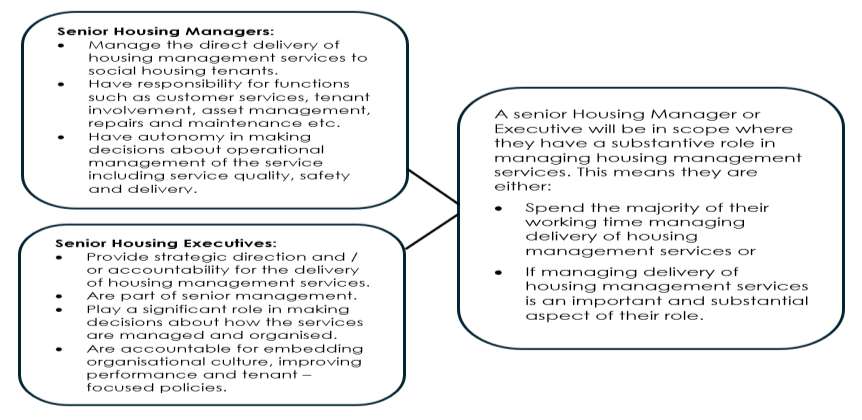
Who is in scope of the qualification’s requirements:
Who is not in scope:
- Unpaid volunteers
- Roles delivering exempt functions
Including:
- Back-office roles (legal, IT, HR)
- Construction of new buildings or management of unoccupied buildings.
- Solely or primarily delivering care and support
- Local authority strategic housing functions.
- Colleagues of services providers who do not deliver a comprehensive social housing management service (i.e. only manage one function like asset management).
How does this apply to supported housing / specialist housing provision:
Applies to all types of social housing provided by a Registered Provider including Sheltered and Supported housing and temporary social housing.
Scheme / Court level managers within a specialist supported housing service are usually out of scope if their role is primarily about day to day running, crisis response, and safeguarding. Rather than them having a strategic or operational oversight.
Commencement and transition:
The Standard is due to commence in October 2026. Qualification transition periods (from commencement) are:
- 4 years for registered providers with fewer than 1,000 homes and their relevant services providers.
AHA will maintain a qualification compliance plan that includes:
- Role mapping (who is in scope)
- Current qualification status
- Enrolment plans and timelines
- Reasonable support (time, funding, study leave)
- Contingency arrangements for recruitment/cover.
Evidence:
AHA will retain evidence of:
- Qualification certificates and/or enrolment confirmations
- Progress updates and completion dates
- Any agreed reasonable adjustments or exceptional arrangements.
9. Contractors and Service Providers:
AHA will:
- Set clear expectations for competence and conduct within contracts and service specifications
- Require service providers to have appropriate recruitment, induction, training, supervision and performance management arrangements
- Seek assurance that contractor staff are appropriately trained and supervised
- Monitor performance through contract management, KPIs, audits, case reviews and tenant feedback
- Take action where standards are not met, including contractual remedies.
Where relevant, contracts will include:
- Minimum competence expectations for key roles
- Requirements for training compliance
- Reporting and audit rights for AHA
- Requirements to cooperate with AHA investigations and learning reviews.
10. Tenant involvement:
Tenants will:
- Be informed about AHA’s expectations of colleague’s competence and behaviour
- Have opportunities to provide feedback on service quality and conduct
- Be involved, where appropriate, in reviewing this policy and related standards.
Tenant influence will include (as appropriate):
- Tenant feedback on service standards and behaviours
- Scrutiny of performance, complaints learning and service improvement actions
- Review of how accessible and effective this policy and the Code of Conduct are in practice.
Tenant feedback will be used to inform training, service improvement and performance management.
11. Monitoring, Assurance and Reporting:
Compliance with this policy will be monitored through:
- Audits and internal reviews
- Appraisal outcomes and training/qualification records
- Tenant satisfaction data, complaint’s themes and learning actions
- Contract management reports and provider assurances
- Board oversight and assurance reporting.
The Board of Management retains overall responsibility for ensuring AHA can demonstrate compliance with the Standard.
Board assurance:
Lead by the People & Culture Committee (PAC) and the Development & Asset Committee (DAC), at least annually, the Board will receive an assurance report covering:
- Training compliance (mandatory and role‑specific)
- Qualification compliance for in‑scope senior roles
- Trends from complaints, incidents and tenant feedback
- Contractor/service provider assurance
- Any material competence or conduct risks and mitigation plans.
12. Non-Compliance:
Failure to meet the requirements of this policy may result in:
- Additional training or supervision.
- Formal performance management action.
- Disciplinary action.
- Contractual remedies (for service providers).
Material or systemic issues may be escalated to the Board and may result in targeted service reviews or independent assurance.
13. Review:
This policy will be reviewed:
- At least every three years.
- Following any significant regulatory change, updated guidance, or learning from serious incidents.
- Where tenant feedback or service performance indicates the need for update.
14. Related Policies and Procedures:
- Code of Conduct
- Code of Ethics
- Contractors Code of Conduct
- Learning and Development Policy
- Appraisal Forms
- Capability Policy
- Safeguarding Policy
- Complaints Policy
- Equality, Diversity and Inclusion Policy
- Procurement and Contract Management Policy.
15. Appendix:
Appendix 1: Compliance template and tools (Governance 360)
Appendix 2: Mandatory and role specific training matrix (SAFEHR)
Appendix 3: Annual Board Assurance Summary Template (Governance 360)